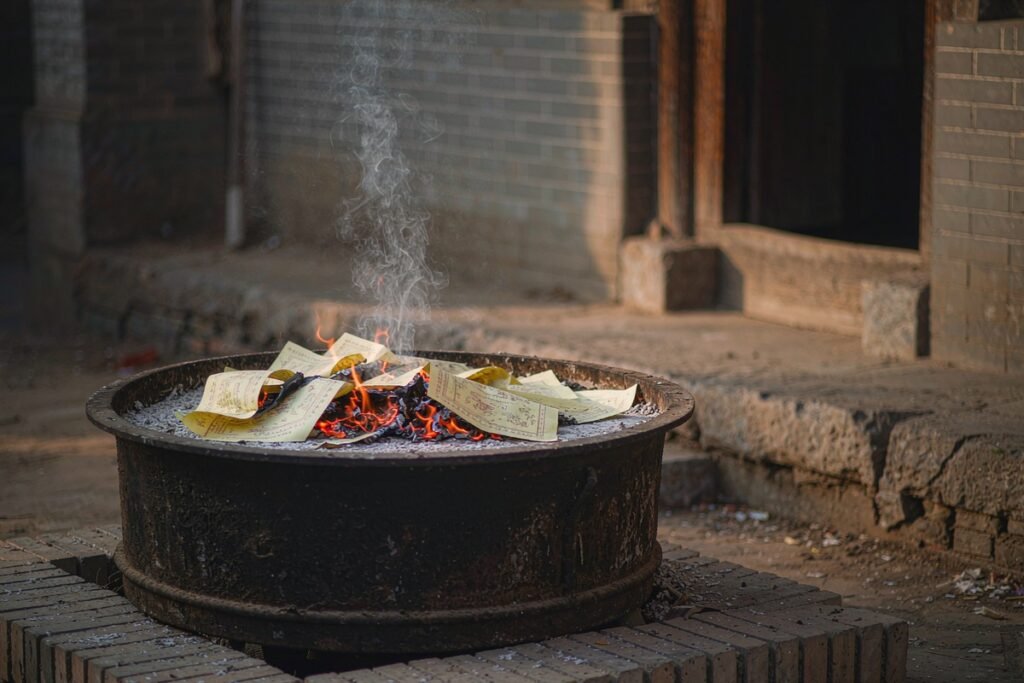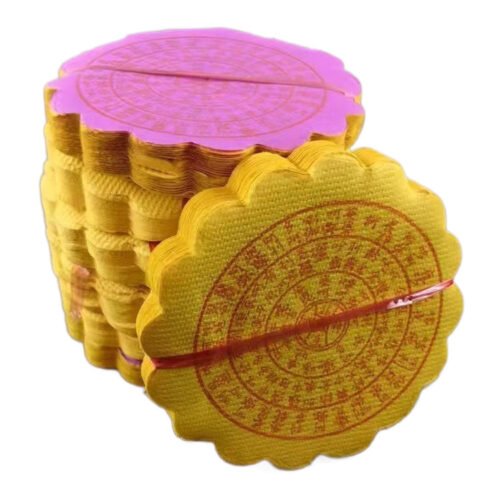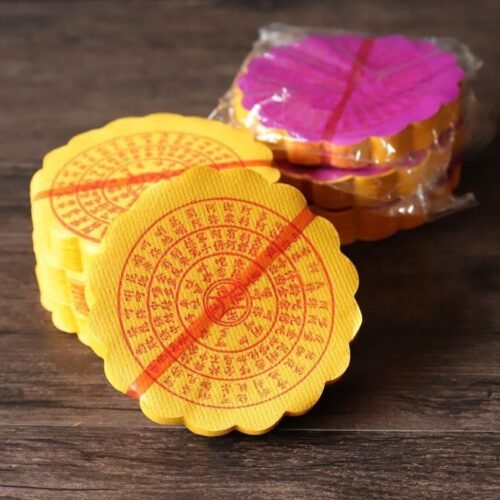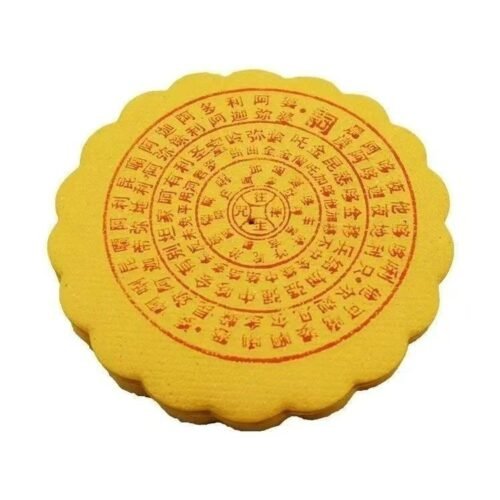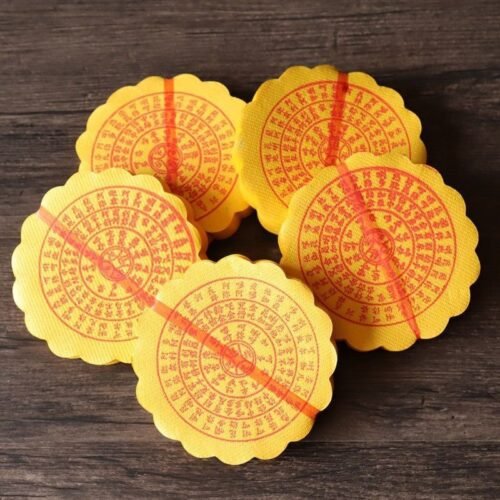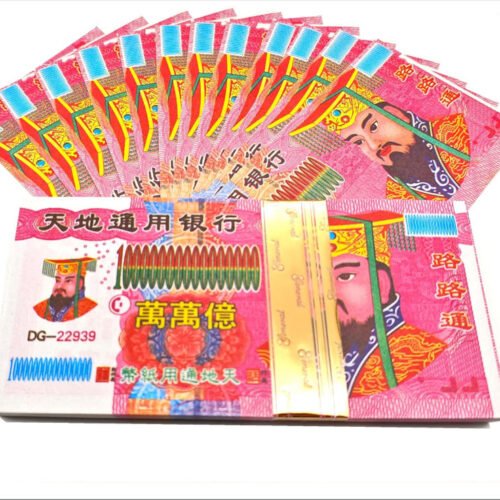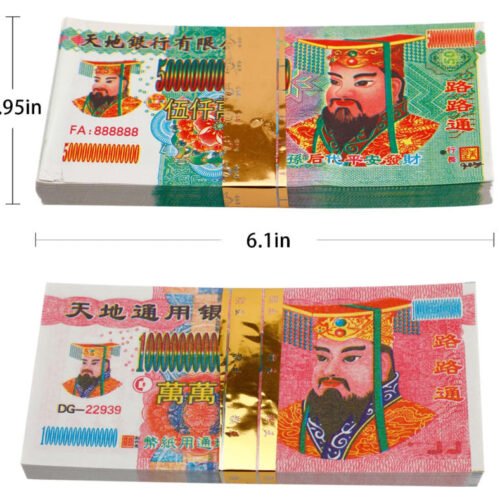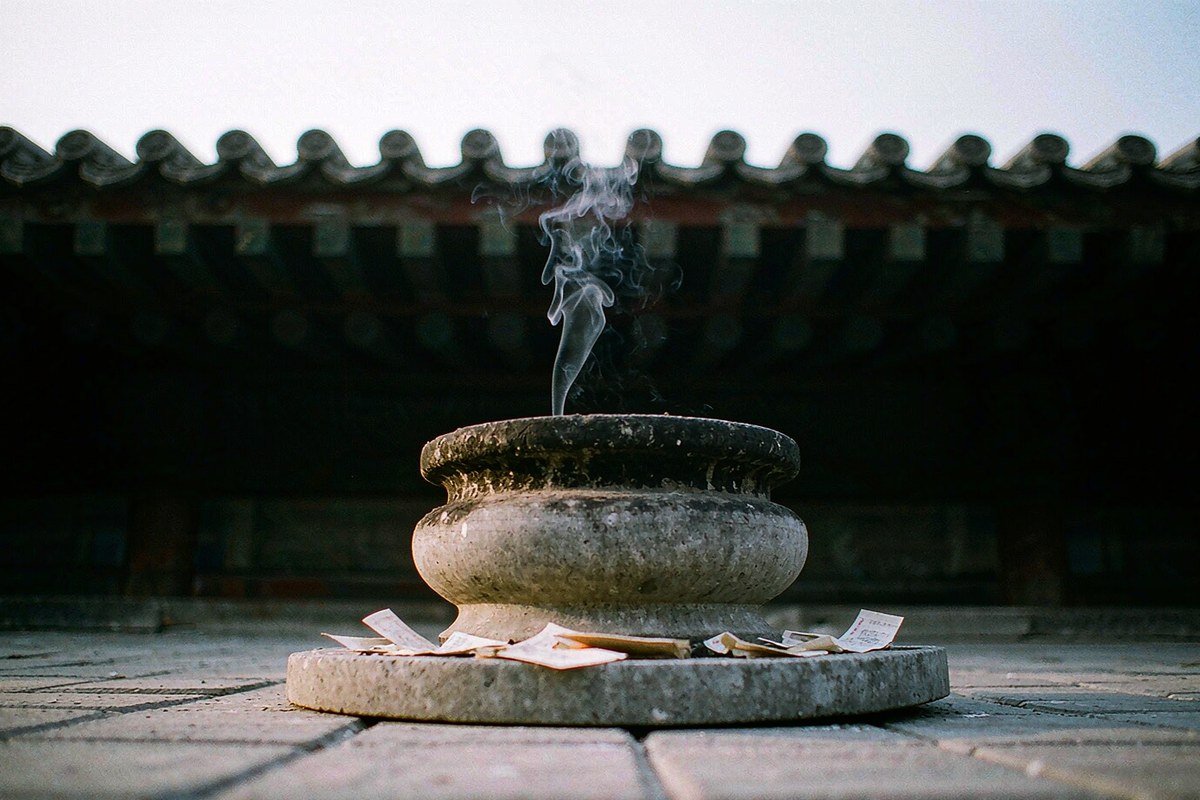
Yes. Paper is burned upward as well as downward, and the upward direction is older. The same flame that carries a banknote to a grave carries gold paper up to the Jade Emperor. What decides the direction is the grade of the sheet and the address on the petition, not the fire.
Is there paper money for heaven?
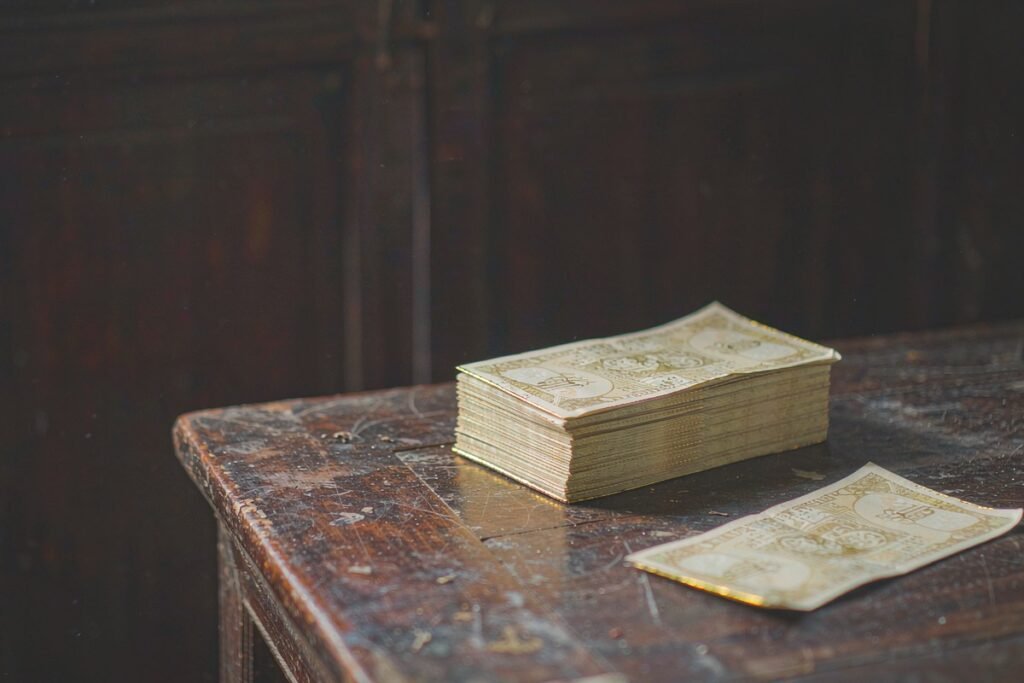
There is, and it has a name, a size and a price. In the Hokkien and Taiwanese system the top grade is tian gong jin — sky lord gold — and it is not a general-purpose sheet. It goes to one recipient. You would not burn it for a grandfather, and if you tried, an older relative would take it out of your hand.
The grades are not decorative. They are a postal system. Gold addresses upward: Heaven, the Three Officials, the City God, the god of a specific temple. Silver addresses downward: ancestors, the newly dead, and the unattached spirits fed in the seventh month. Same mills, same bamboo pulp, two directions.
That is the half the English phrase “hell money” cut off. The term came from nineteenth-century foreign observers watching street burnings during the ghost festival. It described what they could see. What they could not see was the other half, performed at a different altar, with a different grade of paper, on a different date. If you want the object itself defined first, what ancestor money is and what it is for is the place to start.
The fire went up first
Burning for Heaven is not a later addition to a funeral custom. It is the older rite, and it is written into the ritual canon a thousand years before anyone printed a banknote.
《礼记·祭法》 · Liji, “Ji Fa” (Treatise on Sacrifice), compiled c. 1st century BCE
燔柴于泰坛,祭天也;瘗埋于泰折,祭地也。
Pile the wood on the great altar and burn it: that is the sacrifice to Heaven. Bury the offerings in the great pit: that is the sacrifice to Earth.
Read the two halves against each other. One chapter of the Liji pairs burning with burying — flame for the sky, earth for the ground. Two directions, one grammar of offering. When paper eventually replaced bronze and pottery, it took over both slots without changing either. Nothing about the fire changed. Only the thing being fed to it got cheaper.
Shang oracle bones record liao sacrifices, bundles of wood and grain and animals committed to flame, three thousand years before the first paper note. The direction was settled long before the medium. Anyone who tells you that burning paper is a folk accretion around ancestor worship has the order backwards.
What is sky money in Chinese religion?
Sky money is the largest and most expensive sheet in the system, and the quantities are small. A family buys three bundles, not thirty. Here is how the common grades divide, with the sizes we actually handle in the courtyard.
| Grade | Sheet size | Foil | Addressed to |
|---|---|---|---|
| Tian gong jin (sky lord gold) | about 48 cm, the chi liu size | full-face gold, largest area | the Jade Emperor only |
| Shou jin (longevity gold) | about 39 cm, the chi san size | large gold square | higher deities, temple gods |
| Yi jin, fu jin | 20–30 cm | small gold square | minor deities, earth god, door gods |
| Da yin, xiao yin (silver) | 20–39 cm | silver, no gold | ancestors and the dead |
Two things are visible in that table and worth saying out loud. Gold and silver are different products, not different labels on the same product. And the price ladder runs the direction you would expect: the sheet for the highest god in the pantheon is the biggest, and the one for your grandmother is a plain silver rectangle.
Can you burn joss paper for gods?
You can, and in the folk calendar you do, on fixed days. The largest is the ninth day of the first lunar month, the Jade Emperor’s birthday, when the burner in a temple courtyard is lit before dawn and the queue is longer than on any other day of the year. Families arrive with two whole stalks of sugarcane, roots still on, tied with red string. After the rite you cut it up and eat it. That is not symbolism. It is breakfast after standing in the cold for two hours.
Three rules hold in any courtyard that has been doing this for a while:
- The offering table stands higher than a standing person. The god is not looking up at you.
- Gold and silver never share a burner, and never share a session. If both are going, gold first, then sweep the drum.
- The petition names the recipient. Not “the gods”. One of them, by title.
The second rule is the one visitors break, usually by adding a bundle of silver to the gold “for the family”. It is a breach of etiquette rather than a catastrophe, and nothing happens to you. But the ash from the two mixes, and whoever owns the drum will tell you about it for the rest of the afternoon.
The other direction, in a Tang poem
《寒食行》 · Wang Jian, Tang dynasty, 9th century CE
三日无火烧纸钱,纸钱那得到黄泉。
Three days without fire, so no paper money is burned; and how then would paper money ever reach the Yellow Springs?
That is a complaint, not a doctrine. Wang Jian is describing the cold food festival, when lighting a fire was forbidden, and pointing out the plain consequence: a ban on flame is a ban on delivery. The destination is named in the same breath. Nine hundred years after the Liji paired flame with sky, the same practice was running in the other direction, and a poet could assume his readers knew what “the Yellow Springs” meant.
Both directions have been running ever since. Same courtyards, different days, different paper. The grief underneath the practice is older than either, and it is written down in a poem families still read aloud at funerals: Liao E, the Book of Songs lament for a debt to your parents that cannot be repaid.
What the direction actually depends on
Three things, and none of them is the size of the fire.
- The grade of the sheet. Gold up, silver down. This is the load-bearing rule.
- The petition. The slip you write the name and the wish on. It states who is being addressed and who is asking.
- The burner. A raised stone for gold, a low iron drum for silver. In our courtyard the two stand four metres apart, which is the cheapest possible way to prevent a mix-up.
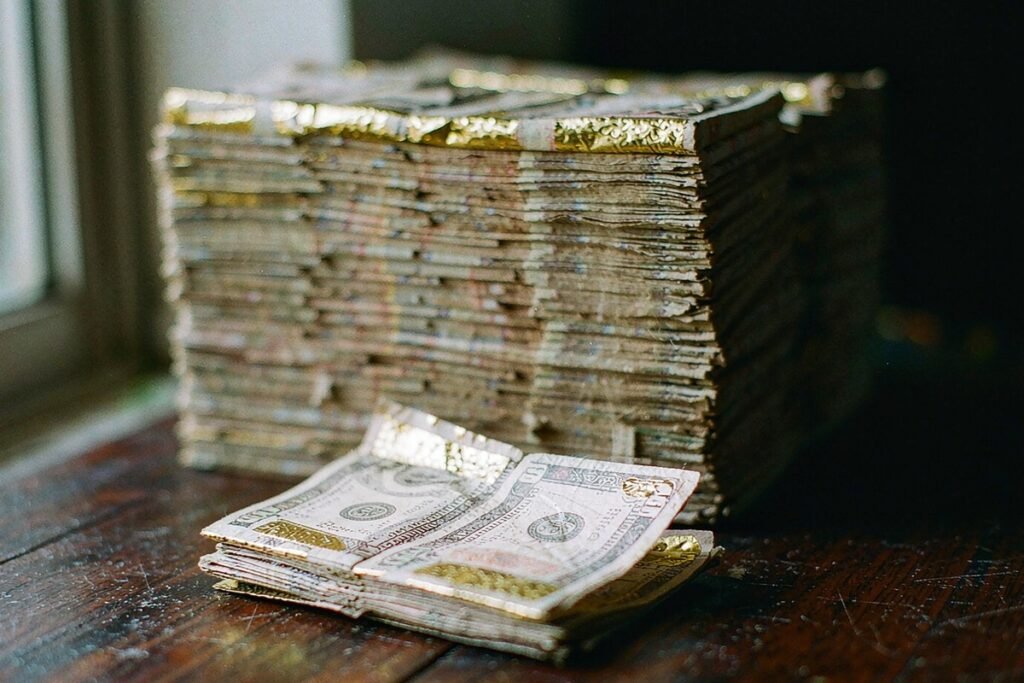
If you are holding a bundle and are not sure which grade you have, look at the foil. Silver, matte, no gold: it goes down. Gold, bright, covering most of one face: it goes up. If the sheet is printed to look like a dollar bill, it is a modern novelty, and the working convention is that it goes down, to whoever you name.
That last category is most of what we sell — USD ancestor money in 100-bill packs, 80 gsm bamboo pulp, foil-laminated on one side — and we say on the product page that it is addressed to the dead, not to Heaven. Use it for your father. Do not use it for the Jade Emperor.
What we will not claim
We do not know what arrives, and nobody at the temple claims to. The rite is a set of actions performed correctly or incorrectly, and our job is the correctness: the sheet, the address, the day, the order. Whether the smoke is received is not something we can report on. Any supplier who tells you it is has invented a guarantee.
What we can report is what happens in the courtyard. People stand in the cold, hand over a name, watch the paper catch, and then go and eat sugarcane.
Common questions
Do I have to burn gold paper at a temple, or can I do it at home?
Both are done. At home the constraint is physical: these sheets are large, they flare, and the foil throws sparks. Use a metal tray with a lid and keep it clear of anything that can catch. Most apartment leases will not allow it, which is why people carry it to a temple instead.
Is it wrong to burn ancestor money for a god?
It is a mismatch rather than a sin. The grade signals the recipient, so sending a silver note upward is like addressing a letter with the wrong postcode. Buy the right grade, or skip the paper and offer fruit.
Why is the Jade Emperor’s paper the most expensive?
Because it is the largest sheet with the largest foil area, and the foil is the expensive part. A pack of sky lord gold costs several times a pack of silver, for the same count of sheets.
Can I burn paper for a god on any day?
The fixed days — the ninth and the fifteenth of the first lunar month, the third of the third month — are when temples expect it. On other days, ask first. Plenty of temples keep one burner and will not light it outside the calendar.
Does the smoke have to go straight up?
People watch it, and they read it. A column that rises cleanly is taken as a good sign; smoke that blows sideways into the crowd is not. We have no explanation for the first and no remedy for the second. Wind is wind.
If you are holding paper and are not sure it is the right paper, it usually is: silver, addressed to them, burned on a day that means something to you. A temple deposit with the name and the wish read aloud costs $12.94, includes a hundred sheets of ancestor money, and comes back with the photograph and the ash.
If you want the upward direction done properly — gold, right day, right height — tell us the date in advance and we will quote it. We will also tell you if we think you do not need it. And if the point is to carry something home afterwards, the hand-painted five element talisman goes through the smoke of your own burn, at $29.99, ordered or not.